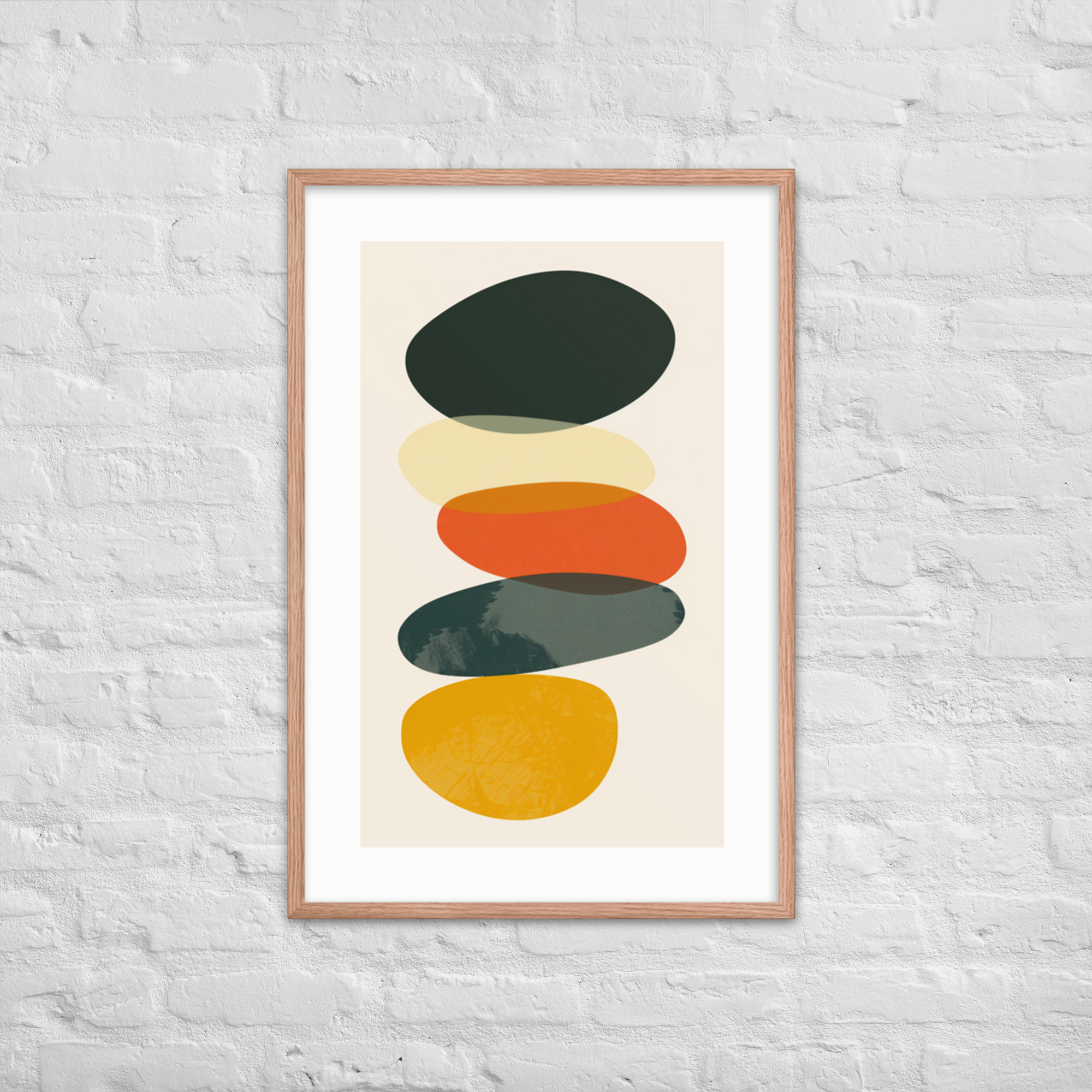
Mid-century modern design history is a story about what happens when a generation of designers decides that good design is a democratic right rather than a luxury. In the aftermath of World War II, with a growing middle class eager to furnish new homes, designers in America and Europe responded with furniture and objects that were simultaneously visionary and accessible: experiments in new materials, new forms, and new manufacturing techniques that brought thoughtful design to mass production for the first time. The result was a movement whose visual language, geometric clarity, organic warmth, and bold chromatic confidence, has proven more durable than almost any other design period of the 20th century.
This post covers the origins and development of mid-century modern design, the key movements and designers who shaped it, the defining visual motifs that came out of it, and how those motifs live on in the art print tradition today. It is designed as the historical context hub for the Mid Mod Style print catalog: every category post in the blog links here because understanding the history is the fastest way to understand why a particular print looks right in an MCM interior.
For the prints themselves, start with our Complete Guide to Mid-Century Modern Art Prints.
A Movement Born of Innovation and Necessity
In the aftermath of World War II, the world was changing rapidly. The post-war boom brought unprecedented prosperity, and with it, a growing middle class eager to furnish their new homes. Designers responded to this demand by creating furniture and decor that was not only stylish but also affordable and functional. The mid-century modern movement was born, marked by a willingness to experiment with new materials, technologies, and forms.
The movement spanned roughly from the mid-1940s to the late 1960s, a period characterized by significant social, economic, and technological changes that fundamentally influenced the design world. The post-war boom led to a growing middle class, increased prosperity, and a surge in homeownership, creating a demand for functional, stylish, and affordable home furnishings. For the first time in design history, mass production was not a limitation but an opportunity: the right design could reach anyone, not just those who could commission a craftsman.
This democratizing ambition is what distinguishes MCM from the luxury design periods before it. Art Deco was made for the wealthy. MCM was made for everyone. Charles Eames put it directly: “We don’t do ‘art’ and we don’t do ‘commerce.’ We do the best we can.” The best they could, it turned out, was very good, which is why their work is still being studied, reproduced, and lived with 70 years later.
The Roots of Mid-Century Modernism: Bauhaus and the International Style
To understand mid-century modern, you need to understand its two principal predecessors. The Bauhaus, a German art school founded in 1919, established that art, craft, and industrial manufacturing could and should be unified. Its principle was that a teapot and a building should follow the same design logic: functionality first, ornament only if it serves function, and materials respected for what they actually are rather than disguised as something else. The Bauhaus closed in 1933 under Nazi pressure, but its faculty scattered across Europe and America, carrying the pedagogy with them. When those teachers ended up at places like Chicago’s Institute of Design and Harvard’s Graduate School of Design, the Bauhaus method became the foundation of American modernist design education.
The International Style, which emerged in the 1920s and 1930s in architecture, reinforced this logic. The International Style favored simple geometric forms, open floor plans, and the unapologetic use of industrial materials: steel, glass, concrete. Its principle was that a building’s exterior should honestly express its structure rather than disguise it behind decorative cladding. When this style was applied to residential architecture in California by designers like Richard Neutra and Pierre Koenig, it produced the glass-walled houses that are now the iconic image of mid-century modern living: homes that dissolved the boundary between inside and outside, that brought the California landscape directly into the living space through floor-to-ceiling glass.
These two movements gave mid-century modern its structural principles: honesty about materials, rejection of applied ornament, integration of interior and exterior. What MCM added was warmth, color, and organic form, which the more austere Bauhaus and International Style had deprioritized.
The Key Designers and Their Influence
The mid-century modern movement was shaped by a specific group of designers whose work remains the canonical reference for the aesthetic.
Charles and Ray Eames are the movement’s most iconic figures. Their contributions include the Eames Lounge Chair and Ottoman (1956), the molded plywood chair series, and their work in architecture, film, and exhibition design. The Eameses operated under a single principle: the best for the most for the least. Their work in molded plywood and fiberglass demonstrated that design intelligence and manufacturing capability, combined correctly, could produce objects that were both better and cheaper than what had come before.
George Nelson, as design director for Herman Miller, created some of the era’s most recognizable pieces: the Marshmallow Sofa, the Ball Clock, the Coconut Chair. Nelson also created the famous “Storagewall” concept, which anticipated the built-in storage and open shelving approaches that remain a core element of MCM interiors today. His influence extended to graphic design and typography, making him one of the era’s genuine polymaths.
Eero Saarinen embodied the sculptural ambition of MCM design. His Tulip Chair (1956), Womb Chair (1948), and TWA Terminal at JFK Airport (completed 1962) all share a sweeping, continuous-surface aesthetic that uses new materials to achieve forms that earlier manufacturing could not have produced. The Womb Chair in particular captures the MCM ideal: organic, enveloping form that is simultaneously functional and emotionally compelling.
Florence Knoll, as designer and head of Knoll Associates, was responsible for bringing the period’s best designers together under a coherent commercial program. She commissioned work from Eero Saarinen, Harry Bertoia, and others, creating the Knoll catalog that became the period’s most influential single source for interior design. Her own designs, the Florence Knoll Sofa and Parallel Bar furniture series, embody the clean-lined, grid-based aesthetic she applied to everything Knoll produced.
Arne Jacobsen, the Danish architect and designer, brought the Scandinavian dimension to mid-century modernism. His Egg Chair, Swan Chair, and Series 7 Chair are among the era’s most reproduced pieces, and his hotel and office interiors (the SAS Royal Hotel in Copenhagen, 1960) demonstrated how MCM principles could scale to institutional architecture.
The Visual Motifs That Defined the Era
Mid-century modern design is identifiable not just by its principles but by its specific visual vocabulary. These motifs are so tied to the era that their presence in any object, from a chair to a textile to an art print, immediately reads as MCM.
Geometric and atomic motifs: The Atomic Age gave MCM design a specific set of visual references. The starburst, derived from nuclear diagrams and Sputnik’s silhouette, appears in wall clocks, textiles, furniture hardware, and art throughout the period. Op art compositions, which use repeating geometric patterns to create optical movement, emerged from the same interest in scientific vision that produced the era’s enthusiasm for astronomy, quantum physics, and space exploration. These geometric compositions are the most immediately recognizable MCM design motif and the most reproduced in contemporary design.
Botanical and organic forms: MCM design’s commitment to connecting interior and exterior spaces extended to its visual vocabulary. Botanical motifs, trees, birds, leaves, branches rendered with graphic precision, appear throughout MCM textiles and art. Alexander Girard’s famous fabric designs for Herman Miller combine folk motifs, botanical forms, and geometric patterns into the era’s most exuberant textile vocabulary. The organic, biomorphic forms of Isamu Noguchi’s furniture, kidney-shaped tables, flowing sculptures, also belong to this tradition: the natural world as a source of design forms rather than design decoration.
Space Age and retro-futurist imagery: The period from 1957 (Sputnik) to 1969 (the moon landing) was the most intense era of technological optimism in American culture, and design absorbed it fully. Rockets, robots, space capsules, and the iconography of a future that seemed genuinely achievable became design motifs across every category: from Pyrex space-age kitchenware to Populuxe architecture’s UFO-shaped coffee shops to the Space Age prints that belong to the MCM art tradition.
Pop art and portrait: Pop art’s emergence in the late 1950s, using mass culture, celebrity imagery, and consumer objects as art subjects, coincided with MCM’s peak commercial moment. The shared visual languages are significant: both use flat, high-contrast color; both reference popular culture without ironic distance; both were made possible by the era’s new printing and manufacturing techniques. Pop art portraits in the MCM tradition bring human presence and cultural energy into interiors that might otherwise lean entirely toward the abstract and geometric.
How Mid-Century Modern Design Lives On in Contemporary Art Prints
The mid-century modern visual vocabulary has proven more durable than almost any other design movement of the 20th century, and its durability comes from exactly the qualities the designers themselves valued: these forms work because they are structurally sound, not because they are fashionable. A starburst composition is engaging to look at not because starbursts were popular in 1958 but because radial geometry creates visual energy in ways that other compositions do not. A botanical print in the MCM tradition is calming and beautiful not because pressed flowers were trendy but because natural form has always been a reliable source of visual pleasure.
At Mid Mod Style, every print in the catalog connects to one of the visual traditions described above. The seven collections map directly onto the visual vocabulary of the era:
The Geometric and Abstract collection draws from the starburst, op art, and atomic motif tradition. The Botanicals collection continues the MCM tradition of natural imagery rendered with graphic precision. The Pop Art and Portraits collection brings the human presence and saturated color of pop art into contemporary print form. The Space Age collection continues the era’s retro-futurist imagery. The Architecture collection celebrates the glass-walled homes and civic buildings of the MCM golden age. The Landscape and Quiet Scenes collection brings the MCM interior’s connection to the natural world into art print form. The Classic Cars collection taps the era’s love of automotive design and American industrial optimism.
None of these collections is nostalgic in the sense of looking backwards. They are continuation, not revival: the visual logic of the MCM era applied to new subjects with the same underlying design discipline.
Explore the Mid Mod Style Print Collections
For the prints themselves, the Complete Guide to Mid-Century Modern Art Prints covers all seven collections in detail, with buying guidance and room-specific recommendations. Browse the full catalog in our shop.
The Visual Legacy of MCM Design in Contemporary Art Prints
Understanding the historical movements covered in this post is one way to appreciate why mid-century modern art prints look the way they do. The motifs that appear across our collections are not decorative choices made in isolation: they are direct descendants of the design conversation that the movement’s key figures were having in the 1940s, 1950s, and 1960s.
The starburst and atomic motifs in our geometric collection come directly from the atomic-age excitement of the post-war period: the belief that science and technology were opening a new world, and the visual language that emerged to express that belief. The botanical and bird imagery in our botanicals collection reflects the movement’s deep interest in the natural world as a source of organic form, a counterpoint to the era’s technological optimism. The space age imagery in our Space Age collection picks up exactly where the atomic-age aesthetics left off: the rockets, robots, and galactic imagery of the late 1950s and 1960s as both subject matter and design vocabulary.
The architecture prints in our architecture collection are perhaps the most direct historical reference in the catalog: these are prints that depict the actual built environment that MCM design produced, the Eichler homes, the Case Study houses, the clean-lined residential designs that put the movement’s principles into concrete and glass. Hanging one of these prints is, in a small way, a tribute to the designers who built the movement’s most permanent physical legacy.
For a complete guide to exploring these collections and finding the prints that best suit your space, visit The Complete Guide to Mid-Century Modern Art Prints.