

Ray Eames was born Bernice Alexandra Kaiser on December 15, 1912, in Sacramento, California. Her family called her Ray Ray. She trained in abstract expressionism before the movement had a name, at the Hans Hofmann School of Fine Arts in New York, working seriously as a painter through the late 1930s. She went to Cranbrook Academy of Art in Michigan, where she met Charles Eames. They married in 1941. In the decades that followed, they made the furniture that defined the American century. When Charles died in 1978, Ray continued running the Eames Office until her own death ten years later.
The partnership shorthand is Charles and Ray. The shorthand is accurate and also, in the way of all useful shorthand, slightly wrong. Not about what they produced together, which is not in dispute, but about what each of them contributed to producing it. This post is an attempt to be more specific about that.
Before Charles, There Was a Painter
The biographical narrative tends to start at Cranbrook, where the collaboration began, which means it skips the decade when Ray Kaiser was building a serious career as an abstract artist in New York. She studied under Hans Hofmann, whose school was one of the crucibles of what would become abstract expressionism. This was not a background activity. Hofmann’s students and circle included many of the painters who would define postwar American art, and the intellectual environment Ray was working in during the late 1930s was one of the more serious in American visual culture at the time.
She contributed work to the first Exhibition of American Abstract Artists in 1937 and continued exhibiting through the early 1940s. She was, by any reasonable measure, a working artist with a developed practice and a community of serious peers, before she was ever a designer, before she met Charles, before there was anything called the Eames Office.
This matters because the conventional reading of the partnership, which frames Charles as the architect and structural thinker and Ray as the artist who made the work beautiful, is not wrong exactly but it mistakes the direction of influence. Ray did not bring art to Charles’s structural thinking. She brought a visual education that was more rigorous and more complete than his, in the domains that would define what the furniture looked like and how it was experienced in a room.
Cranbrook and the Collaboration
Cranbrook Academy of Art, outside Detroit, was in the 1930s and 40s the most interesting design school in the United States. Its approach was less about training designers in existing traditions and more about putting serious artists and designers in the same environment and seeing what happened. Charles Eames was there as an instructor; Ray enrolled as a student. The furniture they would become famous for did not exist yet. Neither of them had made anything that resembled it.
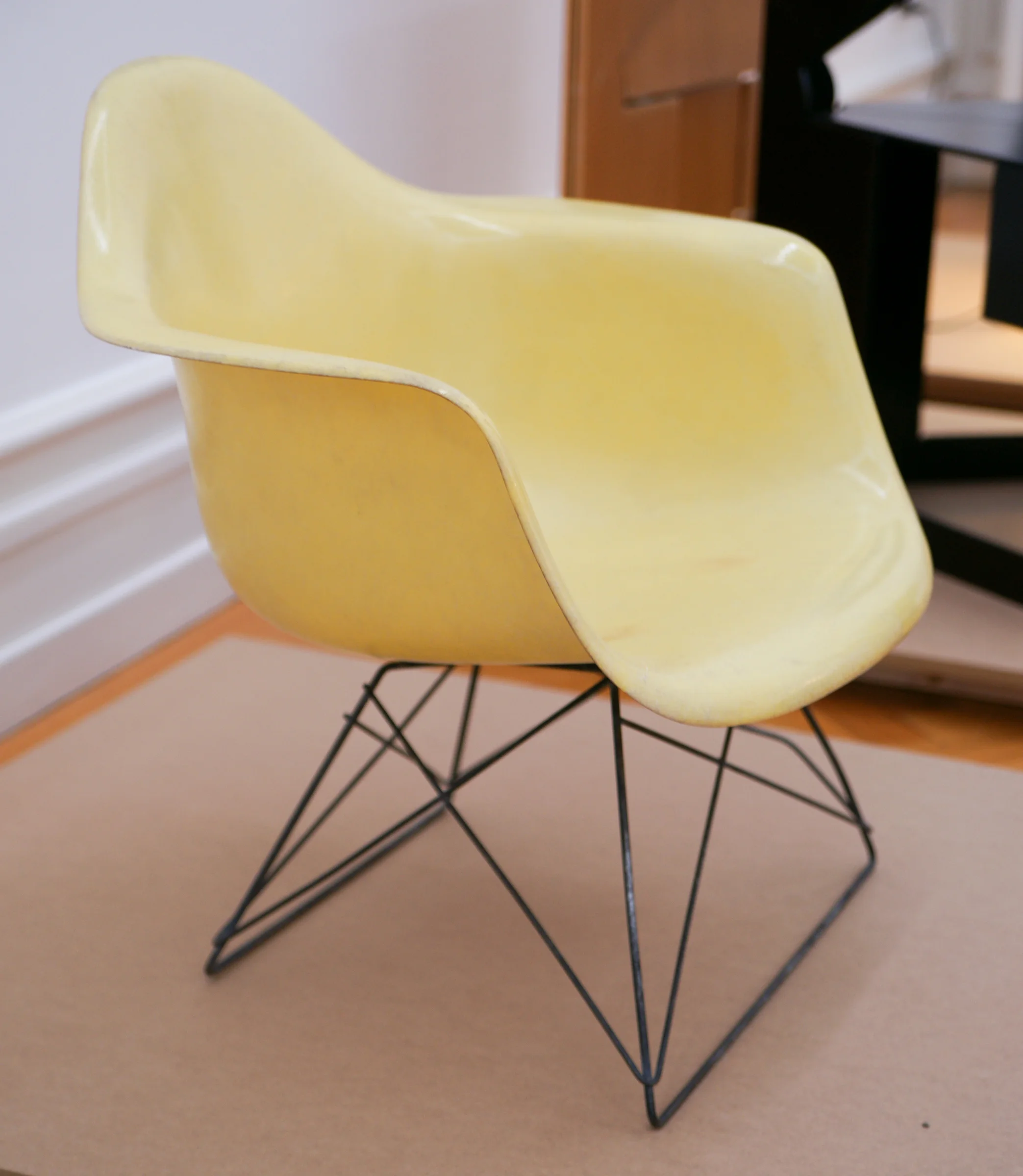
The early plywood experiments, the work that would eventually produce the chairs, began at Cranbrook and continued after they married and moved to California. These experiments were exercises in making the material do something it had not done before: hold a complex curve without cracking, be shaped into forms that were simultaneously comfortable, structurally sound, and visually resolved. The organic shapes that resulted, which are now so familiar that they look inevitable, were not inevitable. They were argued over, failed, and refined across hundreds of prototypes.
The argument about who contributed what to those shapes is not one that lends itself to resolution, because the collaboration was genuinely collaborative in the way that only very close working partnerships are. What can be said with more confidence is this: Ray’s training in abstract form, in the behavior of shape and color and composition as things to be understood in themselves, gave the partnership a visual vocabulary that Charles’s architectural training did not independently provide.
What She Designed
Listing Ray Eames’s specific design contributions requires some care, because the Eames Office itself did not always attribute work by individual hand. This was, in part, a deliberate position: Charles and Ray spoke consistently about the work as shared, and both resisted the biographer’s instinct to partition the collaboration.
What is well documented: Ray designed fabrics and textiles for the chairs, including the original upholstery materials and colors that defined how the furniture looked in rooms. The palette of the Eames body of work, the specific relationships between material tones that made a plywood chair against a white wall look composed rather than sparse, reflects her training in color as a subject of study rather than as decoration.
She also designed covers and layouts for Arts and Architecture magazine, the same publication that sponsored the Case Study House Program. These were serious works of graphic design: bold, spare, and compositionally confident in ways that show a designer who understood the page as a visual field rather than a container for text. The covers are, in a modest way, the Eames visual sensibility expressed without furniture getting in the way.
The exhibition work is perhaps the clearest evidence of what Ray brought. The large-scale installations the office produced, the multi-screen film presentations, the touring museum exhibitions, the landmark projects like “Mathematica” for IBM, required a visual intelligence that could organize information at the scale of a room rather than an object. Ray was centrally involved in all of this work. The spatial and compositional thinking it required was not architectural in the conventional sense. It was closer to what her earlier painting training had developed in her.
The Lounge Chair and What It Obscures
The Eames Lounge Chair and Ottoman, designed in 1956 for Herman Miller, is the most famous piece the office produced. It is also, in a way, the piece most likely to mislead. The chair is beautiful and has aged beautifully; it is still in production; it appears in films and television and waiting rooms and the offices of people who want to signal something about their taste. It is easy to let the chair stand in for the entire body of work.
But the lounge chair arrived fifteen years into the partnership, and the fifteen years before it are where the collaboration was most generative and most difficult. The molded plywood work of the early 1940s, the fiberglass shell chairs of the late 40s and early 50s, the experiments in prefabricated construction that produced their own house in Pacific Palisades (Case Study House #8, completed 1949). These are the work of a partnership that was figuring out what it was, not one that had already become famous. The lounge chair is a destination. The earlier work is a journey, and the journey is where Ray’s contribution is most evident and least credited.
Ten Years Alone
Charles Eames died on August 21, 1978. He was 71. Ray was 65, and she was by that point more than a partner: she had been, in many senses, the operational center of the Eames Office for decades. After his death, she continued to run it, managing the legacy of the work, declining offers that would have diluted the catalog, protecting the integrity of the designs against the pressures of licensing and reproduction that began arriving almost immediately.
She did not reposition herself after his death. She did not give interviews that reassigned credit. She continued to speak about the work as theirs, which is the word she had always used and which she apparently believed was accurate. There is something in this, call it loyalty or call it conviction, that is the most interesting fact about her character.
She died on August 21, 1988. Ten years to the day after Charles. Whether this is coincidence or something more intentional, the Eames Office did not say, and Ray was not there to be asked. The fact tends to land quietly when you hear it.
What the Shorthand Gets Wrong
Charles and Ray is the right shorthand in the sense that it acknowledges the partnership rather than erasing one half of it. It is the wrong shorthand in that it does not invite the next question, which is: what did each of them bring, specifically, and what did the collaboration produce that neither of them would have produced alone?
The answer to the last part is the furniture and films and exhibitions and graphic design of the Eames Office, which could not have been made by a structural thinker without a visual artist, or by a visual artist without a structural thinker. The shorthand is right that both are necessary. It is incomplete in that it does not say which one was which.
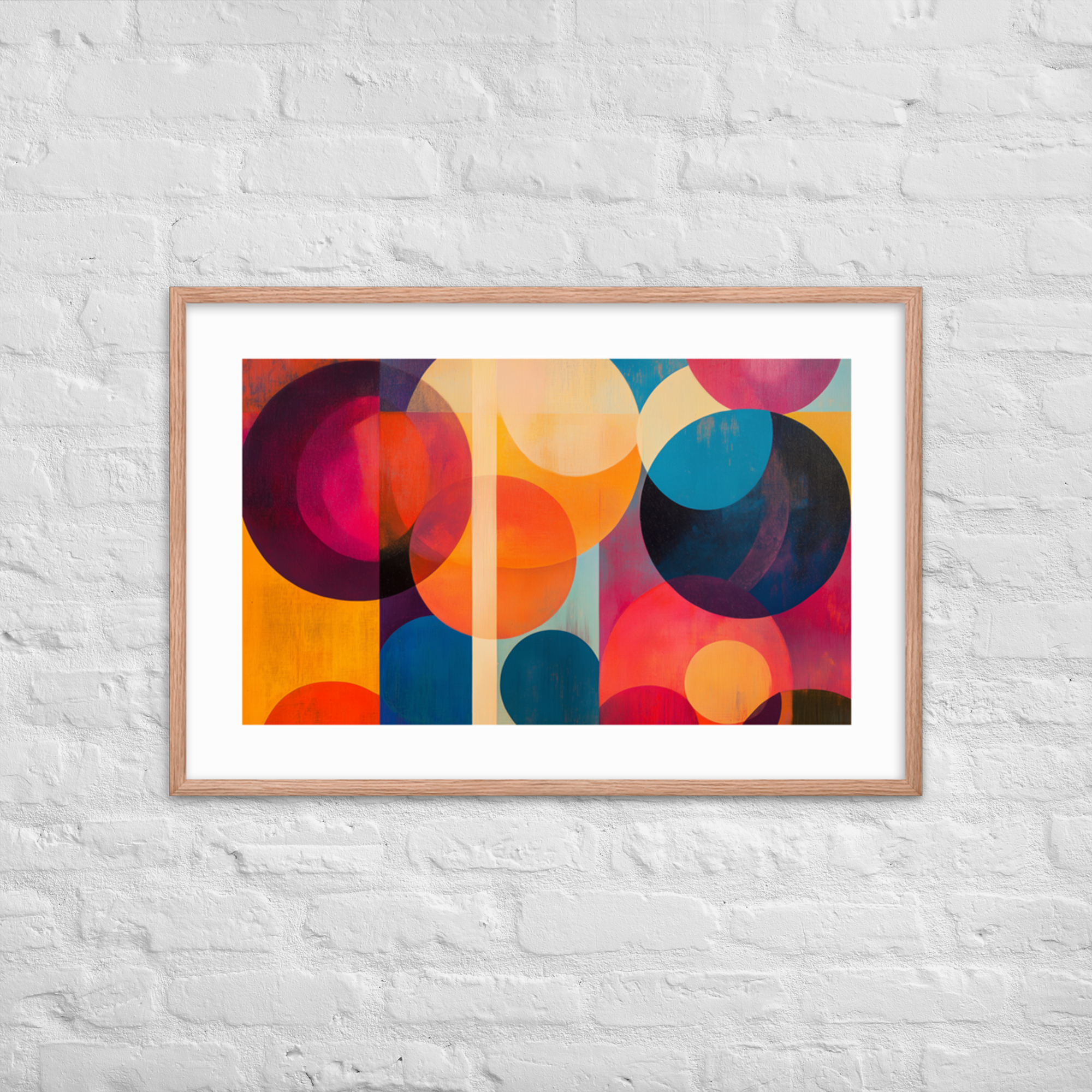
The history of mid-century modern design covers the broader context of the era in which the Eames Office was working. The Mid-Century Architecture collection includes prints drawn from the visual vocabulary that Charles and Ray helped define, including imagery from the period of the Case Study Houses that the office was directly involved in building.
The chair will always say Eames. The question is which one you mean.